Free beta UK Self Assessment for employees with company shares
Your shares get taxed in two places. Nothing tells you the number.
- Payslip · month 12 · RSU vest £7,050.00 ✓
- Release confirmation · broker · the same vest £7,050.00 ✓
- Payslip chain · pay to date, 12 of 12 £186,159.16 ✓
- P60 · pay for the year £186,159.16 ✓
Four documents from three organisations. One number. Rounded down to the pound, the way the box takes it.

A vest is pay on your payslip and a disposal at your broker. An ESPP purchase has a cost you were never shown. Somewhere in that pile of PDFs is the figure HMRC is waiting for. Tracepaper reads the documents on your own device, checks every figure against the other documents that should agree with it, and shows you the box values with the working behind each one.
See it work on an invented year — no sign-up Get a free beta pass
The example is an invented year built from the test fixture the engine is developed against: no sign-up, no card, and nothing of yours goes into it. How it works, if you would rather read first.
Free while it is in beta. One field, no account, no card, and the pass comes back on this page. No cookies, no trackers, nothing loaded from anyone else.
It is a beta, and here is what that means. It has been measured on documents from two employers, though most of that testing is one employer’s payroll. Yours may be the first documents of their kind it has seen — what happens when that is so is written down rather than glossed over.
Who it is for
If any of this is your evening in January
- “My vests show up as pay and as a sale. I can’t tell whether I’m being taxed twice.”
- “Some shares were sold automatically to cover the tax. I don’t know if I have to report that.”
- “My ESPP was bought at a discount and I have no idea what my cost is meant to be.”
- “There are four vests, three sales and a dividend in dollars, and my return wants pounds.”
- “I went over £100,000 and my personal allowance started disappearing.”
- “I want to know in September how much pension allowance I have left, not next April.”
Built for a UK employee, paid through PAYE, holding RSUs or ESPP shares at a US or UK broker, in Self Assessment because of them. It is not built for the self-employed, for landlords, or for anyone whose return is mostly something else.
What it does and does not do yet
What it does: pay, tax and National Insurance from your payslips, P60,
P45 and P11D; RSU vests and ESPP purchases, including
sell-to-cover
Some of the shares are sold on the vest day to pay the tax. HMRC is explicit that you acquire every share first, so those sales are real disposals — and they are in the figures.
What it does not, yet. Before you rely on a figure, this is the whole list — not a selection from it. Where an item applies to you, the app also says so beside the figure it affects.
| What it does not work out | What that means for your figures |
|---|---|
| Pay and tax codes | |
| Scottish income tax | It can read your tax code but will not work out the bill. A code beginning with S means the Scottish rates and bands apply and these figures were worked out with the rest-of-UK ones. |
| The student loan you owe through Self Assessment | It copies across what your employer deducted; it does not calculate what is owed on top. The repayment due on income your employer did not tax is not in the balance. |
| The marriage allowance | If your tax code ends in M or N it can see that, but it neither applies the transfer nor checks whether you are entitled to it. |
| Shares | |
Share schemes other than
RSUsRestricted stock units: a promise of shares that become yours on a vest date. The value on that date is pay, and it goes through your payslip.ESPPAn employee share purchase plan: you buy company shares out of salary, usually at a discount. The discount is taxed as pay, and the price you actually paid is not the cost your gain is worked out from. |
Not share options, SAYE, SIP, CSOP, EMI, or shares under a section 431 election. Nothing from one of those is in the pay figures or the capital gains figures. |
Your employer’s own National Insurance on a vest,
charged to you under an
electionA form signed when you join a share plan that moves your employer’s secondary Class 1 National Insurance on a vest onto you, so that you bear it out of the shares instead of them. |
Where an election or an agreement moves the employer’s secondary Class 1 National Insurance on a vest to the employee, the amount the employee bears comes off the taxable amount of that vest (ITEPA 2003 sections 428A and 481, both headed “Relief for secondary Class 1 contributions met by employee”). This app does not apply that deduction, so the pay for the year and the income tax on it are worked out on the full value of the vest. |
| Pensions | |
The lower
annual allowanceThe most that can go into your pensions in a tax year before a tax charge is due — £60,000, reduced if your adjusted income is over £260,000, and with unused allowance from the three earlier years available on top. |
Once money has been taken flexibly out of a money purchase pension the allowance for those contributions is £10,000 rather than £60,000. There is no way to tell the app that has happened, so the headroom figure assumes it has not. |
| A final salary or career average pension | Only defined contribution schemes are worked out — the ones where
what goes in is a contribution you can point at, whether by salary sacrifice, net
pay or
relief at sourceYour contribution leaves your pay after tax and the scheme claims basic rate back on top of it. Higher and additional rate relief comes through the return, by extending the basic rate band. |
| Other income and gains | |
| Capital gains on anything but listed shares | A second home, a buy-to-let or crypto will leave the gains figures
incomplete. Listed shares are matched properly — same day, the following 30 days,
then the
Section 104 poolAll the shares of one kind you hold, treated as one holding at their average cost. Once a sale has been matched against same-day and 30-day acquisitions, whatever is left comes out of this pool. |
| Interest | It does not read interest from a bank, building society or broker statement, so none of it is in the figures. |
| Property income, self-employment, trusts or partnerships | None of it is read and none of it is computed. A return that is mostly one of these is not a return this is built for. |
| Residence | |
A year split by residence, the
remittance basisBeing taxed on foreign income and gains only when you bring them into the UK, rather than as they arise. It has to be claimed, and claiming it costs you allowances. |
It assumes you are UK resident and domiciled for the whole year. A
split yearA tax year divided into a UK part and an overseas part, because you arrived in or left the UK part-way through it. Only the UK part is taxed as a resident's. |
A vest earned partly while you were working outside
the UK, and the
time apportionmentSplitting the income from one vest between the countries worked in between the grant and the vest, by a count of workdays across that whole period, instead of taxing all of it where you were on the day it vested. |
Where part of the period between the grant and the vest was worked outside the UK, HMRC’s starting position is that the income from that vest is split between the countries worked in, by a count of workdays across that whole period, rather than taxed wholly in the country you were in when it vested (ERSM163120, “Interaction of UK law and treaties — from 6 April 2015: time apportionment”). This app taxes every vest as UK employment income in full, so the pay for the year and the income tax on it are worked out on the whole of it. |
How it works
Three steps, and the second one is the product
-
Put the documents in
Payslips, P60, P11D, P45, release and trade confirmations, 1099-B and supplemental statements, pension and ISA statements. They open in your browser and are stored in your browser. The file itself never goes anywhere — see what leaves your device, which is one thing and is not the file.
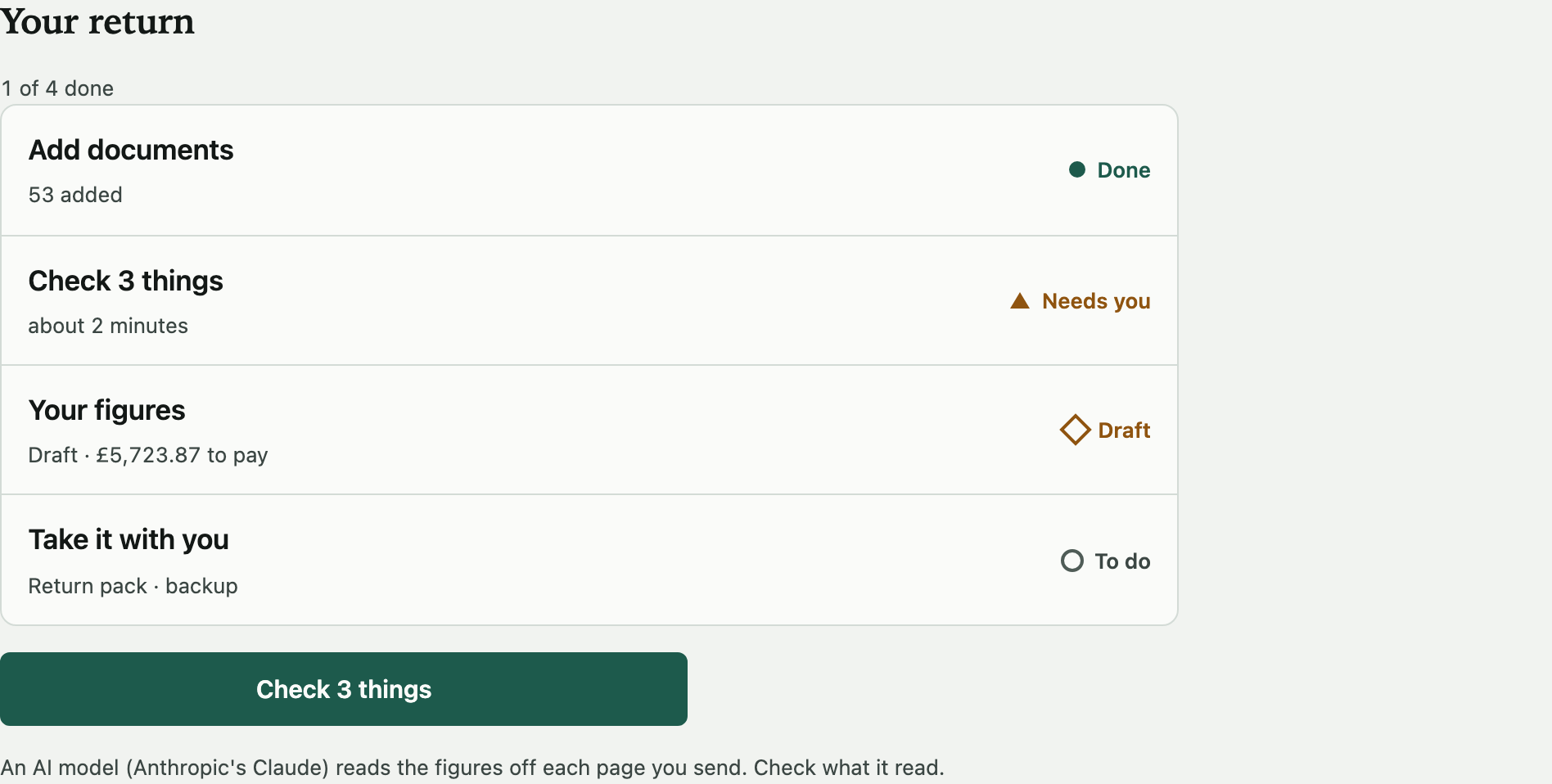
Home is a task list. The invented example year, part way through. A real screen of the app, on the invented example year — open it yourself. -
Nothing is believed from a single reading
A figure that has been read once is a guess. Every document is tested against itself and against the other documents that must agree with it — 87 checks, run on your device:
- I01 the payslip’s own payments minus deductions equal the net pay it prints, to the penny
- I03 each month’s pay-to-date equals last month’s plus this month’s, all the way down the chain
- R01 the P60 equals the sum of the payslips — and the P60 is what your employer told HMRC
- R17 the broker’s release confirmation matches the RSU line on the payslip for the same date
- — tax and National Insurance, recalculated from the printed tax code and category, match the printed figures
When a check fails you are shown both sources side by side and asked which is right. A mismatch is never resolved quietly, and a figure is never changed behind your back.
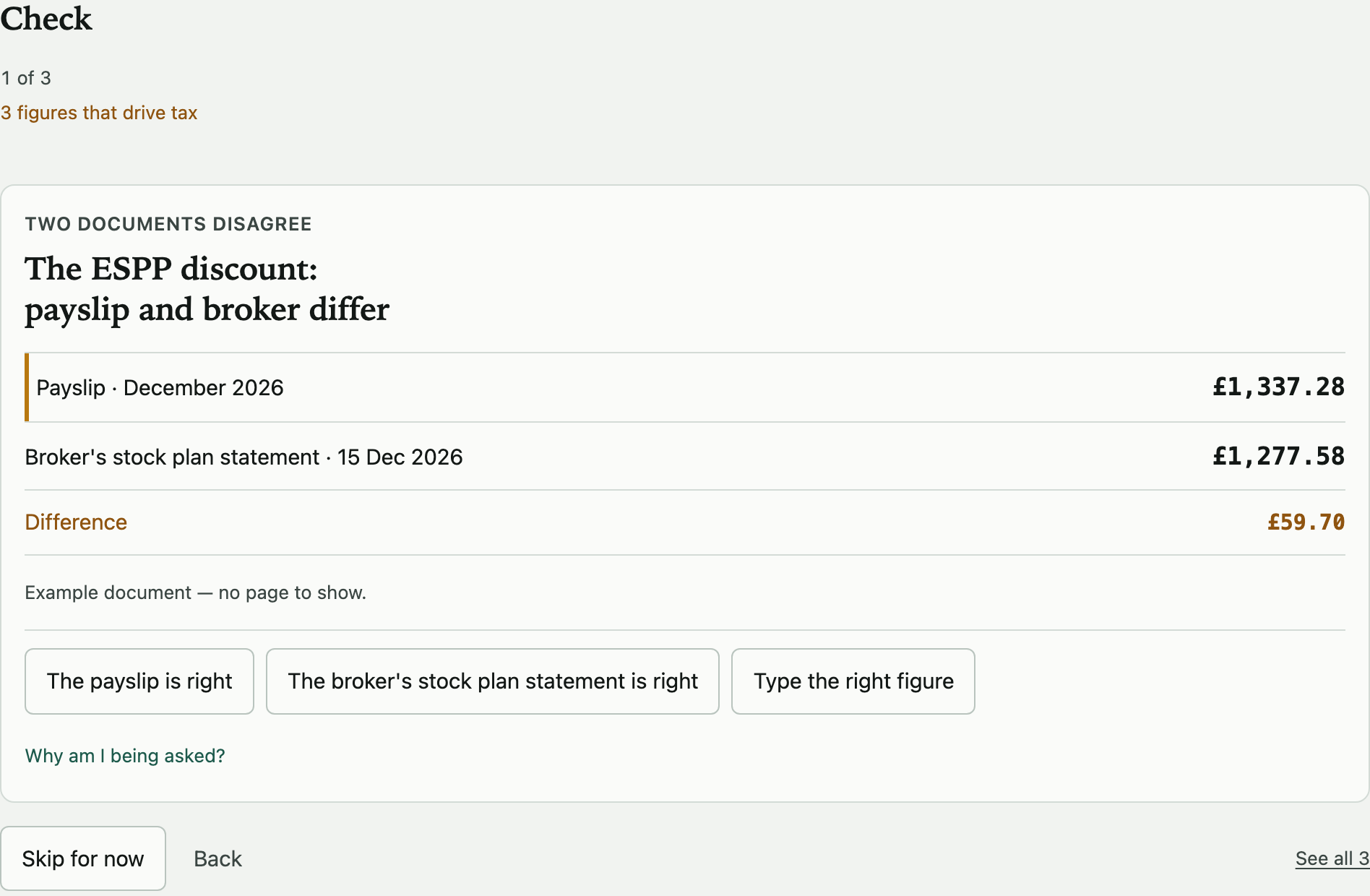
Check, one question at a time: what disagrees, and what to do about it. A real screen of the app, on the invented example year — open it yourself. -
Take the figures and the working
Box values for the return, a computation in which every number names the document, the page and the box it came from, and your pension allowance position for the year you are actually in. You type the figures into HMRC’s own service, or hand the pack to your accountant.
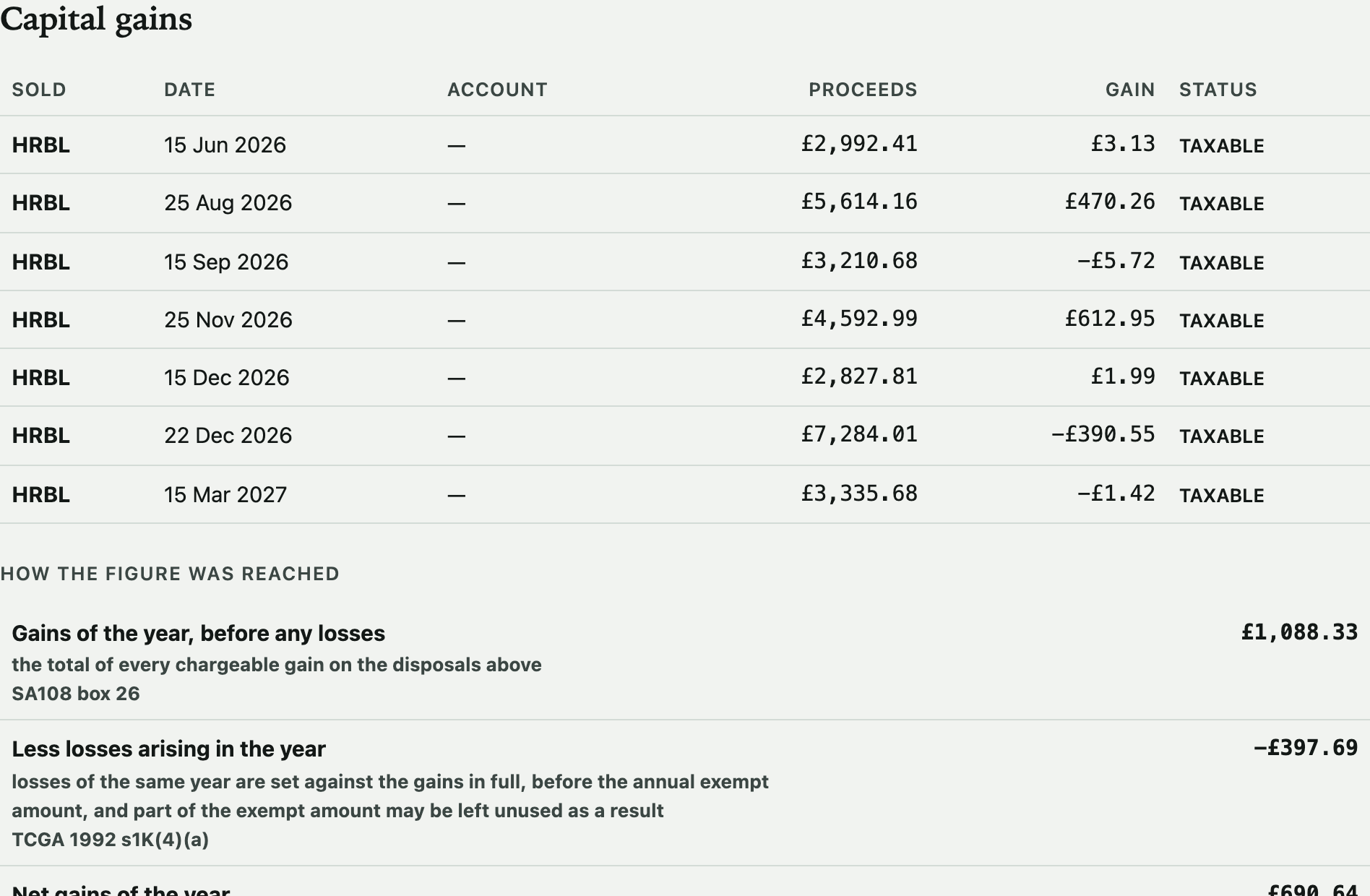
Capital gains: every disposal matched in HMRC's own order. A real screen of the app, on the invented example year — open it yourself.


Run those three steps on your own documents — get a free beta pass →
Privacy
One thing leaves your device. Here is exactly what it is.
Stays on your device
Every document you add, every figure read out of it, every correction you make, the whole calculation and the finished report. They are stored in your browser and nowhere else. The tax engine runs in the browser too: the same Python that runs on a desktop, compiled to WebAssembly, and checked line by line against the desktop run so the answer does not depend on where it was worked out.
There is no account, no password, and no database holding your financial life. If you clear your browser storage, it is gone, which is why the backup is a file you keep.
Leaves your device
A picture of one page, to be read. Before it goes, your browser blacks out your name, National Insurance number, address, employee number and bank details, and stamps the image “Redacted copy — not an original document”. On a payslip it also blacks out the labels it recognises for a union subscription, sick or maternity pay, a health plan or a court order — the label, not the amount. You see the redacted image before it is sent and can black out more of it.
That image travels over an encrypted connection, through a relay we run that logs nothing and keeps nothing of your document, to Anthropic’s Claude API, which reads the figures off the page and sends them back. Nothing else is forwarded — not your email, not an account identifier, because there isn’t one. The relay keeps one number and nothing else: how many documents your beta pass has read, so that the 200 it says it covers is a real number rather than a printed one. The privacy notice says exactly what that record is, and exactly what it does not protect you from.
What we will not claim
- Redaction is a best effort with a step where you check it, not a guarantee. An unusual layout can hide something. That is why you see the image before it is sent.
- Anthropic’s stated default is that inputs are deleted within 30 days, with content flagged by their safety systems kept longer. A zero-retention agreement is available by negotiation and we have not signed one yet. Until we do, the 30 days is the honest answer and this page will say so.
- Your figures are not used to train any model, ours or anyone else’s, and we do not sell data. What we keep, by default, is a fingerprint of the page layout, the names of the fields a check could not confirm, counts of how far you got through the app and how many days you used it on, and which family of browser and system you are on — no amounts, no dates finer than the tax month, no names, no version numbers. You can turn that off and everything still works.
The full privacy notice and terms of use are published here. They have not yet been through a solicitor, and the controller’s legal name, address and contact email are shown on them as marked blanks until they are settled — both facts are stated at the top of each page rather than left for you to find out. What is above is a summary written to match them, not a replacement for them.
Read it, then decide. The pass is free and comes back on this page →
What you get
Box values, the working behind each one, and your pension position
Self Assessment box values
Example · 2026/27| Form | Box | What it is | Value |
|---|---|---|---|
| SA102 | 1 | Pay from this employment | £186,159 |
| SA102 | 2 | UK tax taken off that pay | £64,314 |
| SA108 | 23 | Number of disposals | 7 |
| SA108 | 24 | Disposal proceeds | £29,857 |
| SA108 | 25 | Allowable costs | £29,168 |
| SA108 | 26 | Gains before losses | £1,088 |
| SA108 | 27 | Losses in the year | £398 |
| SA106 | 2 | Foreign tax credit relief on dividends | £57 |
| SA106 | 6 | Foreign dividends, taxable amount | £740 |

The invented year the app opens on, worked out on this device: press the example on this page and these are the figures on the screen. Share matching in the right order — same day, then the following 30 days, then the Section 104 pool — with every dollar amount converted at the rate for its own date. Dividends and the 15% US withholding are carried through to the foreign pages.
A computation that shows its working
Every figure in the pack carries the document, the page and the box it was read from, and the rule that turned it into a return line. If HMRC’s own calculation differs from this one, the working is where you find out why — and HMRC’s figure is the one that counts.
SA102 box 1 ← P60 pay_total_for_year £186,159.16, rounded down · agrees with the final payslip’s pay-to-date to the penny
Your pension allowance position
What you have used this year across salary sacrifice, net pay and relief at source, what your employer has added, your annual allowance — tapered if your adjusted income is over £260,000 — and the carry-forward still available from the three earlier years, oldest first, with the slice that lapses next marked.
You can also move a number and see the arithmetic: if you contributed a further £5,000 to a registered pension scheme in 2025-26, this calculation shows income tax of £A instead of £B, and £C of annual allowance remaining.
That is a calculation from figures you have confirmed. It is not personal advice and not a recommendation to pay into any pension. It does not check whether you are eligible to contribute, or how much a scheme will accept. Tax treatment depends on your circumstances and can change. If you want advice on whether or how much to contribute, speak to a regulated financial adviser, or use MoneyHelper, the free government-backed guidance service.
What it is not
The things this does not do, said plainly
- Not tax advice
- It calculates from the documents and confirmations you give it. It does not weigh up your circumstances or tell you what to claim, and it is not a substitute for a qualified tax adviser or accountant.
- Not financial advice, and not an authorised firm
- We are not authorised or regulated by the Financial Conduct Authority. Nothing here is a personal recommendation, and nothing here is an inducement to invest in or contribute to any product.
- Not a filing service
- It produces the figures and a sheet telling you what to type where. You file your own return through HMRC’s service, or your accountant does. Nothing is submitted to HMRC on your behalf.
- Not HMRC, and not connected to HMRC
- An independent tool. HMRC’s own calculation is always the one that counts.
- Not yet tested on your employer’s payslip
- This is a beta. It has been measured on documents from two employers, though most of that testing is one employer’s payroll: reading checked field by field against a hand transcription, and the calculation tested to the penny against the employer’s own deductions. 165 of 165 fields were read correctly on one person’s year, at one of the two employers, and 100% of the tax-driving fields across the 36 genuine documents in the measured run of September 2026. Yours may be the first documents of their kind we have seen. When the app meets a layout it does not know, it asks you one question about that document, with every figure shown where it is printed on your own page — and the figures are cross-checked against each other before you are asked anything.
- Not everything, in the first release
- England, Wales and Northern Ireland income tax. All ten of the things it does not work out yet — Scottish income tax, share schemes other than RSUs and ESPP, a split year, property and self-employment among them — are set out in full, in one table, under what it does and does not do yet. That is the whole list, and it is the same list the app itself uses.
Questions
The six questions people ask before they upload anything
- Is it safe to put my payslip into this?
-
The design is the answer, not the promise. Your documents are opened and kept in your own browser; there is no account and no database of your financial life on our side, because there is nowhere for one to be. One page image leaves, blacked out, and you see it blacked out and press send yourself before it goes.
The two things we will not claim: blacking out is a best effort with a step where you check it, not a guarantee; and the redacted image is read by Anthropic’s Claude API under their stated 30-day default retention, because we have not signed a zero-retention agreement yet. Both are in the privacy section and in the privacy notice.
- What actually leaves my device?
-
One thing: a picture of one page, with your name, National Insurance number, address, employee number and bank details blacked out in your browser first and the image stamped “Redacted copy — not an original document”. It travels encrypted, through a relay we run that logs nothing and keeps nothing of your document, to be read, and the figures come back. The relay keeps one number against your beta pass — how many documents it has read — and nothing else at all.
Not the file. Not your name. Not an account identifier, because there isn’t one. There is no analytics script on this page or in the app, and nothing phones home. Two requests ever leave, and both wait for something you do: the page you asked to have read, and a small readiness check of the relay — carrying your beta pass and nothing else — when you add a document of your own, save a beta pass or the reader’s address, open the panel that holds them, or ask for a document already here to be sent. Opening the app, reopening it with documents still waiting to be read, and running the example year send nothing at all.
- Who are you?
-
to be completed before the beta opens Support is answered by the person who wrote the code, not a ticket queue, and the four questions we ask after the beta are sent by a person too.
The legal entity and its registered address are being settled now and go on the privacy notice and the terms of use before the first user, not after. Where those pages still show a bracketed placeholder, that is a detail not yet decided — shown rather than hidden.
- What does it cost?
-
The beta is free. No card, no trial that turns into a subscription, nothing on this page takes a payment. The pass you get is good for 200 documents until 31 December 2026.
Pricing comes after the beta and is not decided yet, which the pricing section says rather than guesses at. When there is a price it will be shown here in full — including what happens if you cancel and how refunds work — before anything is charged, and nobody is charged for something they signed up to while it was free.
- What if it gets a figure wrong?
-
It is built on the assumption that it will. A figure read once is a guess, so every figure is tested against the other documents that must agree with it, and each one arrives labelled: corroborated, unchecked, or disagreed. When two sources disagree you are shown both and asked which is right — nothing is resolved quietly behind your back.
Every number names the document, page and box it came from, so you can check it against your own paper. HMRC’s own calculation is always the one that counts. There is a “this figure is wrong” button on every review card; it sends the rule name and the field, and never the figure. It has been measured on documents from two employers, though most of that testing is one employer’s payroll — 165 of 165 fields on one person’s year, at one of the two employers, and 100% of the tax-driving fields across the 36 genuine documents in the measured run of September 2026. Yours may be the first documents of their kind we have seen; what happens then is written down.
A wrong reading is one risk; a figure it was never built to compute at all is another — what it does not do yet is listed on this page, not left for you to find out.
- What happens to my email address?
-
It goes into one store, kept apart from everything else, which holds your address, the id of the pass we issued you, the date, a tag naming the link you followed if it carried one (such as ?src=hn), and the two optional answers about share-plan and payroll software if you gave them. That is the whole record. No name, no employer, no documents, nothing about what you upload, no cookie, no IP address, no analytics. The pass itself carries no trace of it. We do not join that address to the one number the relay keeps against your pass — we keep the two apart — but we would rather be exact than reassuring: joining them would need both the relay’s secret salt and this list, we hold both, and nobody outside holds either. It is a real protection against a breach and against anyone else; it is not a claim that we could not do it ourselves.
We use it for two things: to tell you when the beta opens or changes, and to ask you a handful of questions once you have used it. Ask and we delete it. The app itself never sends us a document, whether or not you have signed up. The full version of this is §3a of the privacy notice.
Pricing
Free during the beta. The price will be on this page before anything is charged.
The beta costs nothing. There is no card, no trial that turns into a subscription, and nothing on this page takes a payment. Pricing comes after the beta and has not been set — not the figures and not the shape. When it is set it will be published here in full, including what happens if you cancel and how refunds work, before anything is charged, and nobody is charged for something they signed up to while it was free.
Beta
Get a beta pass
One field you have to fill in. Give an email address and a pass comes back straight away, on this page — there is no waiting list and no one on the other end typing it out by hand. The two questions under it are optional, and skipping them costs you nothing.
Your beta pass:
That link carries the pass in the part of the address after the # — the part a browser keeps to itself and never sends to any server. If the app asks you for a pass, paste the copy above under "Where pages are sent to be read". It is good for 200 documents, until 2026-12-31.
Keep a copy. A pass is worth 200 documents to whoever holds it, so it comes back only to the browser that asked for it: this page keeps a random secret of its own, sends us only a hash of it, and we hand the pass back to nobody who cannot show it. Clear this browser’s storage and we cannot hand it back — email us and we will reset the address.
We keep your email address, and the two answers above if you gave them — no name, no documents, nothing about what you upload. We use the address for two things: to tell you when the beta opens or changes, and to ask you a handful of questions once you have used it. Ask and we delete it. The app itself never sends us a document, whether or not you have signed up.
In two sentences: the whole record is seven fields at most — your email address, the id of your pass, the date, a tag naming the link you followed if it carried one, the two optional answers, and, only if you ticked the box above, the day you ticked it and which sentence you agreed to. Beside it sits one thing about this browser rather than about you, a hash of a random secret this page made, so your pass can be handed back to this browser and to no other.
What exactly is kept — in full
The two answers are two names of software, chosen from the lists above, kept with your sign-up for as long as it is kept. They are how we decide which payslip and which broker layouts to build and test first, so that the first document you upload is one we have already seen the shape of. Neither is the name of your employer — we do not ask for it, there is nowhere to type it, and anything sent that is not one of the words in those lists is thrown away rather than stored.
One more thing goes in that record, and only if it was in the link you followed: a tag such as ?src=hn, so we can tell which link brought people here. It is a word we put in our own links — it says nothing about you, and it is the only thing about your visit that is kept. No cookie is set, no IP address or browser is recorded, there is no analytics on this page, and nothing here is loaded from anybody else. The whole record is seven fields at most: your email address, the id of your pass, the date, that tag, the two answers, and the launch-news consent below. Beside it we keep one more thing, and it is about this browser rather than about you: a hash of the random secret this page made, so your pass can be handed back to this browser and to no other. It is not derived from your address, your device or anything you typed.
The launch-news box is the seventh field, and only if you tick it. It is never ticked for you, it is not needed to get a pass, and the emails described above — telling you when the beta opens or changes, and a handful of questions once you have used it — come either way. Tick it and we store two things beside your address: the day you ticked it, and an identifier for the exact sentence you agreed to, so we can show later what was agreed and when. Our basis for sending those emails is your consent, and you can take it back at any time by replying to any email from us or using the one-click unsubscribe link every launch email will carry — we then delete that field and nothing else about your record changes. We keep it for exactly as long as we keep your address.
Before you type it in: the privacy notice says what happens to that address and to the one page image that ever leaves your device, and the terms of use say what this is and is not. Both are short, and both show what is still blank.
No luck above? Email the waitlist or write to to be completed before the beta opens
Status Private beta from late September 2026 with a small number of people who lend a document. Public release planned for 11 October 2026.